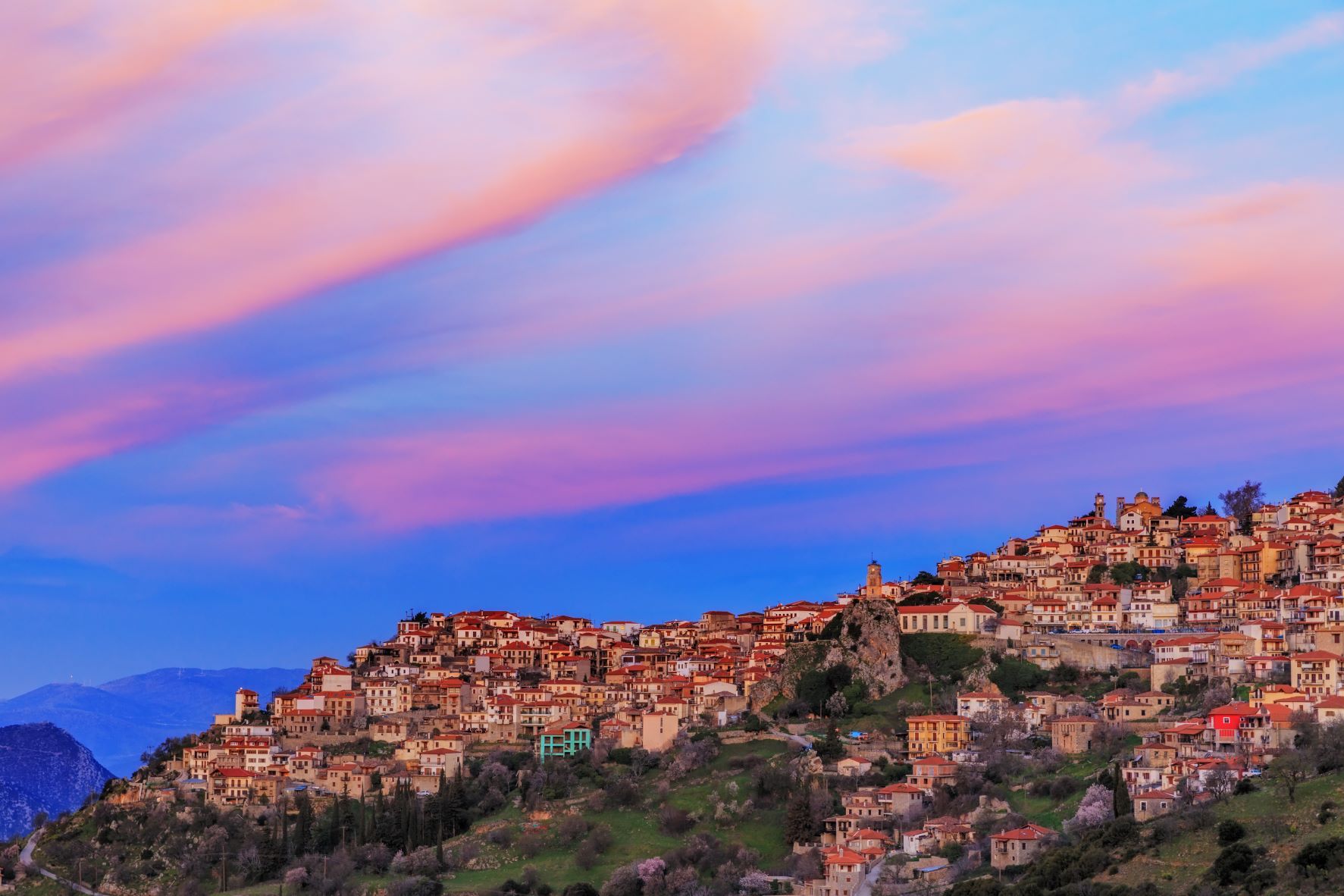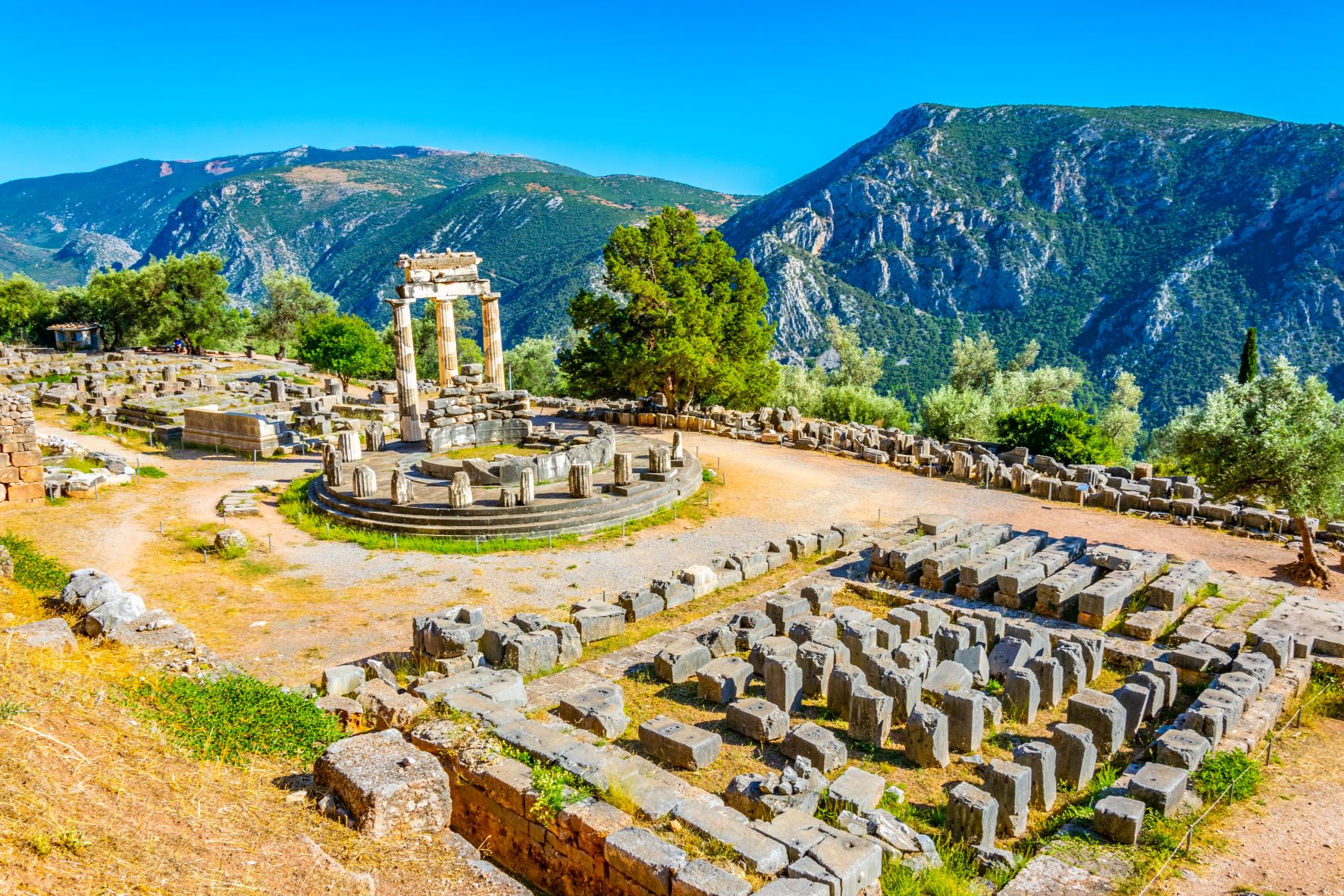
Delphi is situated on the southern slopes of Mount Parnassus in central Greece, approximately 180 km northwest of Athens. It is accessible by car or bus via the Arachova-Amphissa-Itea road.
The archaeological site of Delphi and the adjacent picturesque town are situated on the southwestern slope of Mount Parnassus. It is now an extensive archaeological site with a beautiful modern Museum. Since 1938, it has been part of Parnassos National Park. This important ancient Temple complex today is a UNESCO World Heritage Site, and it is considered by many as one of the most important archaeological sites of Greece. Delphi, a place of long history and beautiful nature, is roughly a 2-hour drive from Athens, making it an ideal destination for a visit.
Delphi has been, since ancient times, a place of worship for Gaia, the mother goddess connected with fertility. Earlier myths include traditions that Pythia, or the Delphic oracle, was already the site of an important oracle in the pre-classical Greek world (as early as 1400 BC) and, rededicated from about 800 BC, when it served as the major site during classical times for the worship of the god Apollo.
The town of Delphi started to gain pan-Hellenic relevance as both a shrine and an oracle in the 7th century BC, as the worship of god Apollo began to spread around Greece. Initially under the control of Phocaean settlers based in nearby Kirra (currently Itea), Delphi was ruled by the Amphictyonic League, a religious and military alliance responsible for the protection of the temple of Apollo.
In 356 BC, the Phocians under Philomelos captured and sacked Delphi, leading to the Third Sacred War (356–346 BC), which ended with the defeat of the former and the rise of Macedon under the reign of Philip II. This led to the Fourth Sacred War (339 BC), which culminated in the Battle of Chaeronea (338 BC) and the establishment of Macedonian rule over Greece.
Romans sacked the oracle many times, and although there were a few attempts, later on to restore the site later on, it gradually lost importance and by the 3rd century AD, it fell into decline. The oracle was shut down completely during the persecution of the pagans in the late Roman Empire by Theodosius I in 381 AD.
Delphi is situated on the southern slopes of Mount Parnassus in central Greece, approximately 180 km northwest of Athens. It is accessible by car or bus via the Arachova-Amphissa-Itea road.
In ancient Greek mythology, Delphi was considered the “navel of the world,” the center of the earth. It housed the Oracle of Apollo, where the Pythia, a priestess, delivered prophecies that influenced major decisions across the ancient Greek world.
The museum showcases artifacts from the sanctuary, including:
Opening Hours:
Ticket Prices:
Free Admission Days:
Yes, a special vehicle is available to transport visitors with mobility impairments up to the Temple of Apollo. Advance notice is required at least 7 days before the visit.
Pets, with the exception of service dogs, are not allowed inside the monasteries.
Book your 2026 trip to Meteora today and enjoy up to 10% off our award-winning tours and stays. Lock in your preferred dates before they sell out — early birds always fly higher!
Use code EARLYBIRD26 at checkout
Offer Conditions:
Valid on selected tours, trips, and activities scheduled to depart between 1 January 2026 and 31 December 2026. The offer does not apply to bookings with start dates from 1 April 2026 to 12 April 2026. Availability is limited and subject to change without notice.